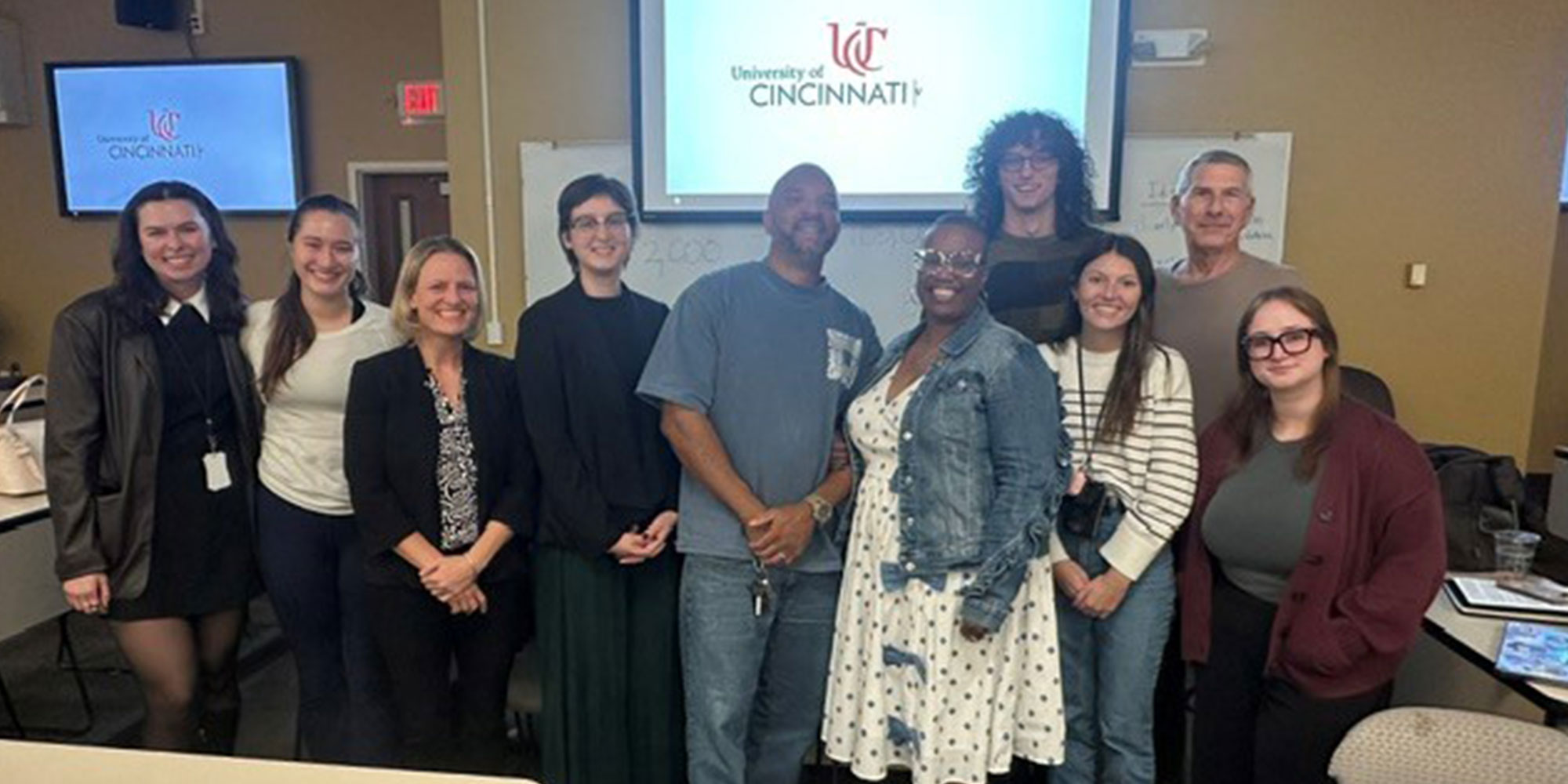
Students gathered at Capital Law School on October 29, to hear a narrative that started with this sentence: “My name is Richard Horton, and I was wrongly incarcerated for 16 years for a crime that I didn't commit.”
For the second year, Professor Paige Kohn invited guests from the Ohio Innocence Project (OIP) to speak to her Justice Advocacy class about wrongful incarcerations and the work of setting them right.
“I hope students connect the importance of academic assignments with real-life situations,” Kohn said. “I hope they see how they can change the world for the better by witnessing a client, here Richard Horton, explain how lawyers helped get him out of prison for something he never did.”
Pierce Reed, Esq., the OIP’s Director of Policy and Engagement, started with some stark statistics. Two million people are currently incarcerated in the United States. 2,000 of those are on death row, and 150 of those death row inmates are here in Ohio. Reed estimated that five percent of people currently on death row are innocent, based on previous exonerations.
“The goal of an Innocence Project is not to lay blame,” Pierce said. “It’s just to point out that somebody made a mistake. It’s not our job to judge people who make those mistakes. Our role is to bring that mistake to the light so people like Richard don’t end up in in the wrong place.”
Reed introduced Columbus native Richard Horton and his wife Janette. Mr. Horton was errantly blamed for a home invasion and found out about the charges at a custody hearing for his daughter.
“I was oblivious,” Mr. Horton said, “The bailiff pulled me aside and whispered, ‘We can’t grant you custody or even consider you because there’s an active warrant out for your arrest. Man, I think you need to get out of here.’”
Despite an alibi and lack of evidence, Mr. Horton ended up on trial.
“I was a little bit cocky,” Mr. Horton said. “I don't have a history of violence. I come to trial every day with a different suit on. I got a full-time job. You’re charging me with taking $40 from this guy? This is clearly not me.”
Certain of Mr. Horton’s innocence, they put their faith in the court.
“I figured the justice system would bring forth justice,” Mr. Horton said. “Well, that didn’t happen. I got found guilty and sentenced to serve 23 years.”
Mr. Horton learned about the OIP in 2015, after exhausting all his state, local, and federal appeals. He wrote to them with the details of his case and asked his family members to call on his behalf. The OIP receives 300-500 requests each year, so Mr. Horton needed his case to stand out.
“I kept writing, I kept calling,” Mr. Horton said. “You know, this is a good case. Take a look at this.”
The OIP took up the case in 2017, and new DNA evidence empowered them to request a new trial. Mr. Horton’s experiences with OIP staff attorney Brian Howe were a welcome contrast to his previous representation.
“Brian’s visits gave me hope, and I could transfer that hope to my wife,” Mr. Horton said. “In prison, having the Ohio Innocence Project working on your case is a big deal. The word innocence is in the title.”
Mr. Horton was finally freed in 2002. To date, the OIP has helped 44 people gain their freedom.
Reed concluded by encouraging the students to honor their profession by prioritizing their own mental health.
“No matter what work you end up doing, you all have to learn how to take care of yourselves,” Reed said. “If you don’t, you’re not going to be an effective advocate. You’re gonna screw up somebody’s case. Now’s the time to put those safeguards into your life.”
At the end of the evening, a student asked how Mr. Horton maintained a sense of optimism despite his experiences.
“Being wrongfully incarcerated for 16 years, you're surrounded by darkness,” Mr. Horton said. “I still have nightmares about stuff I saw in prison. But I try to be a light for my family and my kids. Maybe a light for somebody else, just encouraging them. It’s just so much easier for me to be positive, for me to smile.”