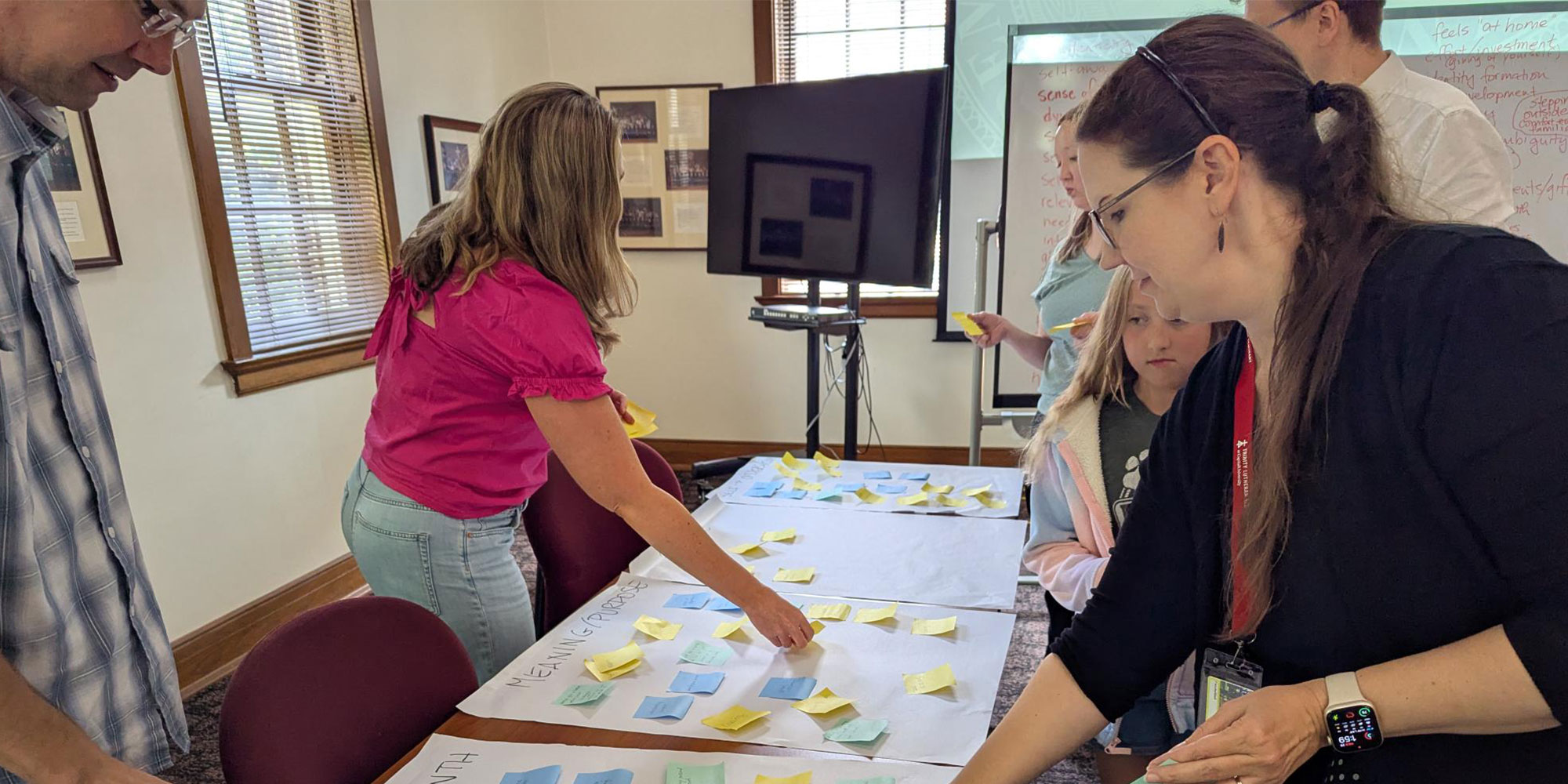
Capital University has received a grant from the Network for Vocation in Undergraduate Education (NetVUE) to support a yearlong initiative exploring what it means to lead meaningful lives.
Nate Whelan-Jackson, associate professor and director of the Signature Learning Program in Religion and Philosophy, along with a team of colleagues, is leading the effort at Capital. He describes the grant as an opportunity to bring the Capital community together around a deceptively simple question: what does it take to educate the whole person?
"This award allows us to better coordinate as staff, faculty, and students to consider what it takes for us to educate for meaningful lives," Whelan-Jackson said. "It allows us to create a space to consider things like what we mean when we want to educate the whole person."
The grant will also fund pilot projects in classrooms and student experiences meant to help the university "determine and support developing a sense of meaning in our particular time and place as part of a Capital University education."
The timing, Whelan-Jackson said, is no accident.
"This is an important moment in thinking through the purposes of higher education more generally," he said. "Clearly, we want our students to be successful in their careers and in their lives. I think it is important that they might also develop a sense of significance as part of this broader project."
Capital's new strategic planning, Whelan-Jackson said, "provides an opportunity to think about the kind of education that we are delivering and what it is that we want for our students.” The grant arrives just as those conversations are already underway.
Central to the project is the word "vocation" itself, a term Whelan-Jackson is careful to distinguish from typical major-selection or job-readiness conversations.
"Often, and very understandably, conversations about career planning focus on lots of specifically financial considerations," he said. "That is very important and does not need to be diminished. I, too, like to buy groceries."
Whelan-Jackson cautioned that career planning is too often framed narrowly around skill-building, "in a way that does not speak to a broader concern for living a rich and meaningful life."
Instead, he explained, "We are thinking about vocation as a process of appreciating the relationships in which we are embedded and seeing the process of career planning and selecting majors as part of a broader, personalized project that informs how we understand ourselves within our communities."
Asked what success will look like a year from now, Whelan-Jackson pointed to something concrete.
"We will have created and refined a campus understanding of vocation that speaks to practices in the classroom and in different student experience areas,” he said.
Small grants awarded across departments, he said, are meant to "bolster the idea within different arenas of a Capital University education" and to "provide some guidance on next steps."
Every funded project will look a little different, he acknowledged, but all will be measured by the same underlying objective: "impact on student experience, a growing understanding and capacity for reflecting on vocation and the importance of shaping a meaningful life."
As the initiative unfolds over the coming year, Whelan-Jackson and his collaborators hope the work will leave a lasting mark on how Capital talks about, and delivers, an education built around purpose.