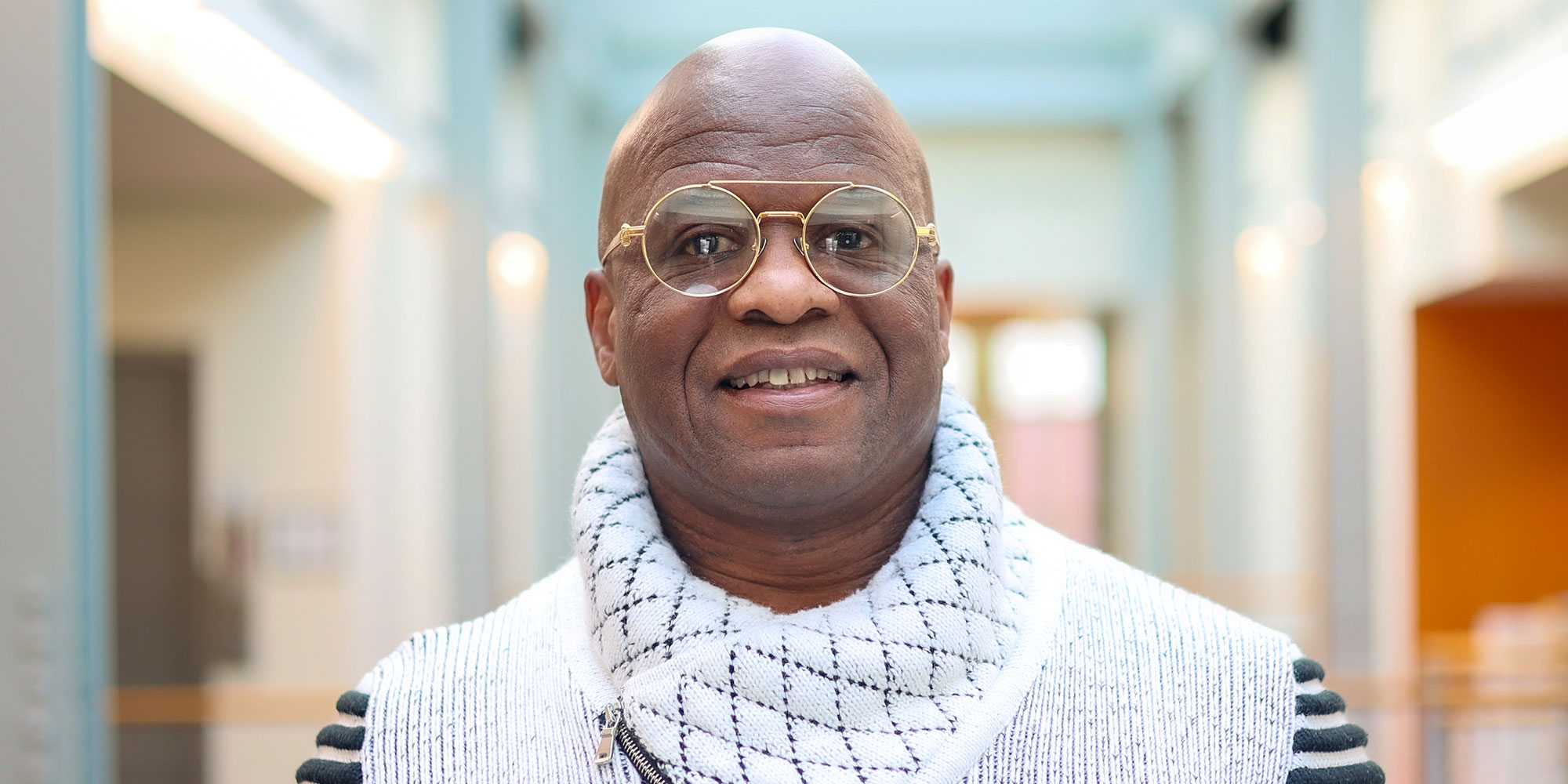
For Mujaddid Muhammad ’26, MSW, social work class of 2025, education is more than a credential, it is transformation in action.
Long before he ever stepped into a college classroom, Muhammad was studying human behavior in the hardest of environments. After experiencing childhood trauma and entering the juvenile justice system at age 12, he would spend more than 30 years incarcerated. During that time, he began to confront the trauma that shaped his life and to recognize a pattern he had seen not only in himself, but in countless others around him.
“Hurt people hurt people,” he said. “I was sexually abused at nine. I grew up in an abusive home and that compounded trauma led me down a self-sabotage and self-destructive path. Along the way, considering my own life and then the lives of others that I encountered, I saw a common thread, which was trauma.”
“As I began to educate myself, social work aligned with my lived experiences. Even in the work that I do today, working with people involved in the justice system, SUD [substance use disorder] population, homeless people, it all aligns with my path. One of the things that I share with them is my own lived experiences and where I come from. They can make better choices about transforming their lives, about turning their lives around. I describe it as putting a face on trauma.”
While incarcerated, Muhammad made a decision that would redefine his future: he would pursue higher education. Even when access to funding was limited and opportunities were scarce, he enrolled in courses and accumulated transferable credits. Education became both a lifeline and a lens, helping him understand the psychological and systemic forces that had shaped his own story.
When he returned home in 2018, he carried with him a clear goal: earn his degree in social work. He already possessed lived experience and hard-earned insight. What he wanted now was academic language, theory, and professional tools to match it.
“When I came home, I worked at a community action agency called Impact Community Action. It was a stipend-based program and a lot of the individuals who came to the program were just cycling through, chasing the stipend,” said Muhammad.
“I talked with my supervisor about wanting to do a trauma-informed awareness component, where we started talking about trauma. About what it looks like when it comes out. From a clinical perspective or academic perspective, a lot of people don't understand because the behavior has become so normal to them that they don't recognize it as trauma. That’s just one way I use what I'm learning in school.”
At Capital, Muhammad found a program that allowed him to merge lived experience with evidence-based practice. Faculty mentors, including Dr. Renda Ross, associate professor in social work, challenged and supported him, helping him refine his voice as both a scholar and practitioner. In the classroom, he engaged deeply with theory. In the field, he applied it immediately.
As a crisis specialist with National Church Residences and through previous leadership roles with Horizon Prison Initiative and IMPACT Community Action, Muhammad has developed programs rooted in accountability, empowerment, and trust. His field placement at Integrated Behavioral Health has further sharpened his clinical skills, particularly in group facilitation.
His master’s capstone project centers on trauma literacy, an initiative designed to help participants recognize how trauma manifests in their thoughts, behaviors, and decision-making. Using pre- and post-surveys built on a Likert scale, Muhammad measures participants’ understanding of trauma before and after completing an eight-week educational module. Sessions explore topics such as fight, flight, freeze, and fawn responses, developmental trauma, and the Adverse Childhood Experiences (ACE) questionnaire.
“The final result that I'm hoping for is an increase in awareness. Individuals going to therapy who maybe haven't even considered it, and mainly just an increase in awareness, understanding how trauma shows up in their lives,” said Muhammad.
In his Intensive Outpatient (IOP) groups, which serve approximately 15 participants, he facilitates honest conversations about stress, loss, and patterns that often go unexamined. Rather than confront individuals directly, he guides them toward insight, creating space for what he calls “aha moments.” His approach blends academic theory with lived understanding, translating complex concepts into accessible language.
For Muhammad, social work is fundamentally about advocacy. He defines the profession simply: “Being an advocate for those who don't have a voice or who don't know how to represent themselves.”
But his advocacy is not abstract. It is relational. He builds trust with clients by showing up consistently, modeling accountability, and demonstrating that change is possible.
Looking ahead, Muhammad hopes to expand his impact by helping develop innovative programming that connects treatment participation with tangible stability, including housing access.
Muhammad’s time at Capital has amplified that advocacy. It has given him research frameworks, ethical grounding, and clinical strategies. It has strengthened his ability to evaluate programs, measure outcomes, and pursue licensure as a Licensed Independent Social Worker (LISW).
At every stage, education has been the bridge between lived experience and life goals. It has allowed him to reframe his past not as a limitation, but as a foundation for service.
To learn more about Social Work at Capital, visit https://www.capital.edu/academics/social-work/.