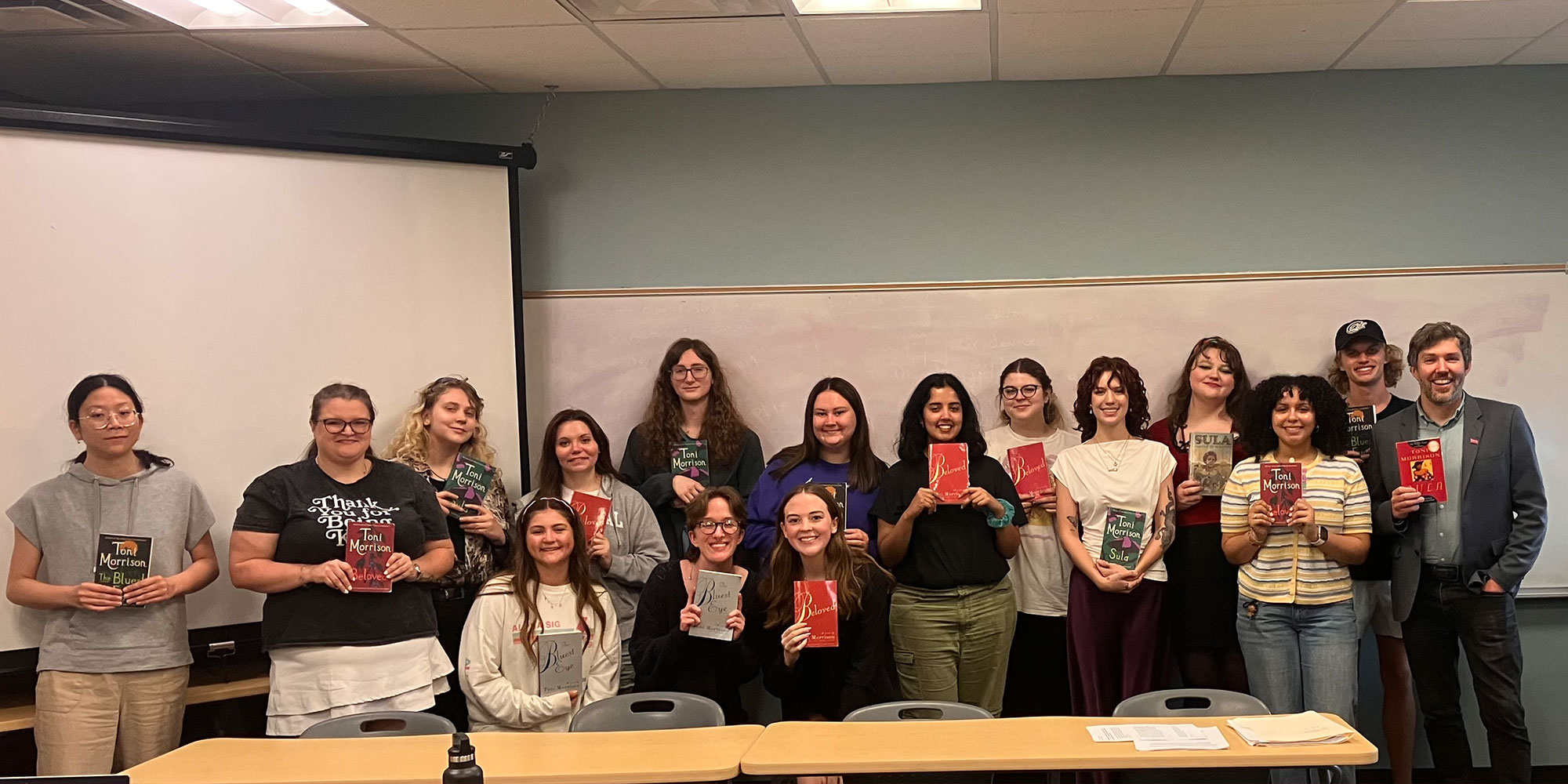
This spring, Capital students explored the life, work, and legacy of one of Ohio’s most celebrated literary voices through a special topics course, “Toni Morrison and Ohio.” Offered during the Spring 2026 semester, the course connected students not only to Morrison’s acclaimed novels, but also to a statewide initiative honoring the Nobel Prize-winning author’s enduring impact on literature, culture, and history.
The course aligned with “Beloved: Ohio Celebrates Toni Morrison,” a yearlong series organized through Ohio Humanities recognizing Morrison’s ties to Ohio and her influence around the world. As part of the celebration, Capital students virtually attended the initiative’s kickoff event on Morrison’s birthday, February 18. The event featured a multigenerational group of scholars, writers, and community leaders reflecting on Morrison’s life and literary contributions while also celebrating the launch of a new scholarly study of her writing.
For Capital students, the experience felt deeply local and personal.
Throughout the semester, students studied Morrison’s Ohio-based novels, “The Bluest Eye,” “Sula,” and “Beloved,” examining how her upbringing in Lorain, Ohio, shaped her storytelling and how her writing continues to influence perceptions of the Midwest, race, identity, and community. The course encouraged students to consider the relationship between literature and place, especially as many students share Ohio roots themselves.
“Toni Morrison’s writing made Ohio feel different to me,” said Hafsa Siddiqui ’26, a journalism/professional writing and creative writing double major. “Knowing that a well-renowned author such as Morrison was from Ohio, the very place this class is at, made the class feel very personal and special. Reading her work through her eyes made me appreciate Ohio in more ways than I originally had.”
Taught by Liam O'Loughlin, Ph.D. associate professor of English, the class challenged students to think critically about interpretation, storytelling, and the role literature plays in understanding culture and history. Morrison’s writing style, known for its complexity and layered meaning, became one of the course’s most impactful lessons.
“One of the things I learned in the course was how Morrison liked leaving things up for interpretation by never explaining her writing,” Siddiqui said. “There are so many ways you can interpret her books that you will never truly get an answer even when you think you finally have it. It made me view literature differently.”
As a final project, students were asked to reflect on how Morrison should be remembered in 2026 and how the themes present in her work continue to resonate today. The assignment encouraged students to connect Morrison’s ideas to contemporary conversations surrounding identity, belonging, memory, and social justice.
For Siddiqui, the course mirrored her broader experience at Capital.
“Every year I have experienced something new that helped with my development as an adult,” Siddiqui said. “I would describe my journey as ‘there’s always room for more.’ This course fits my journey perfectly,mainly because of how you can always find new things or have new realizations through every re-read of a Morrison book, which I think corresponds well with all my new experiences at Capital.”
The course also reflected Capital’s commitment to connecting classroom learning with community engagement. Beyond campus, local organizations and cultural institutions throughout central Ohio joined the statewide Morrison celebration through public programming and literary discussions.
Gramercy Books, Bexley’s independent bookstore, announced a three-part Toni Morrison book club series featuring discussions on “Beloved,” “The Bluest Eye,” and “Song of Solomon.” The events brought together readers, scholars, and community members to continue conversations inspired by Morrison’s work and legacy.
By bridging academic study with statewide cultural engagement, Capital’s “Toni Morrison and Ohio” course offered students an opportunity to see literature not simply as something studied in a classroom, but as a living conversation connected to community, identity, and place. Through Morrison’s words, students gained a deeper understanding of Ohio, of storytelling, and of the lasting power literature has to shape how people see both the world and themselves.
To learn more about English at Capital, visit https://www.capital.edu/academics/english/.