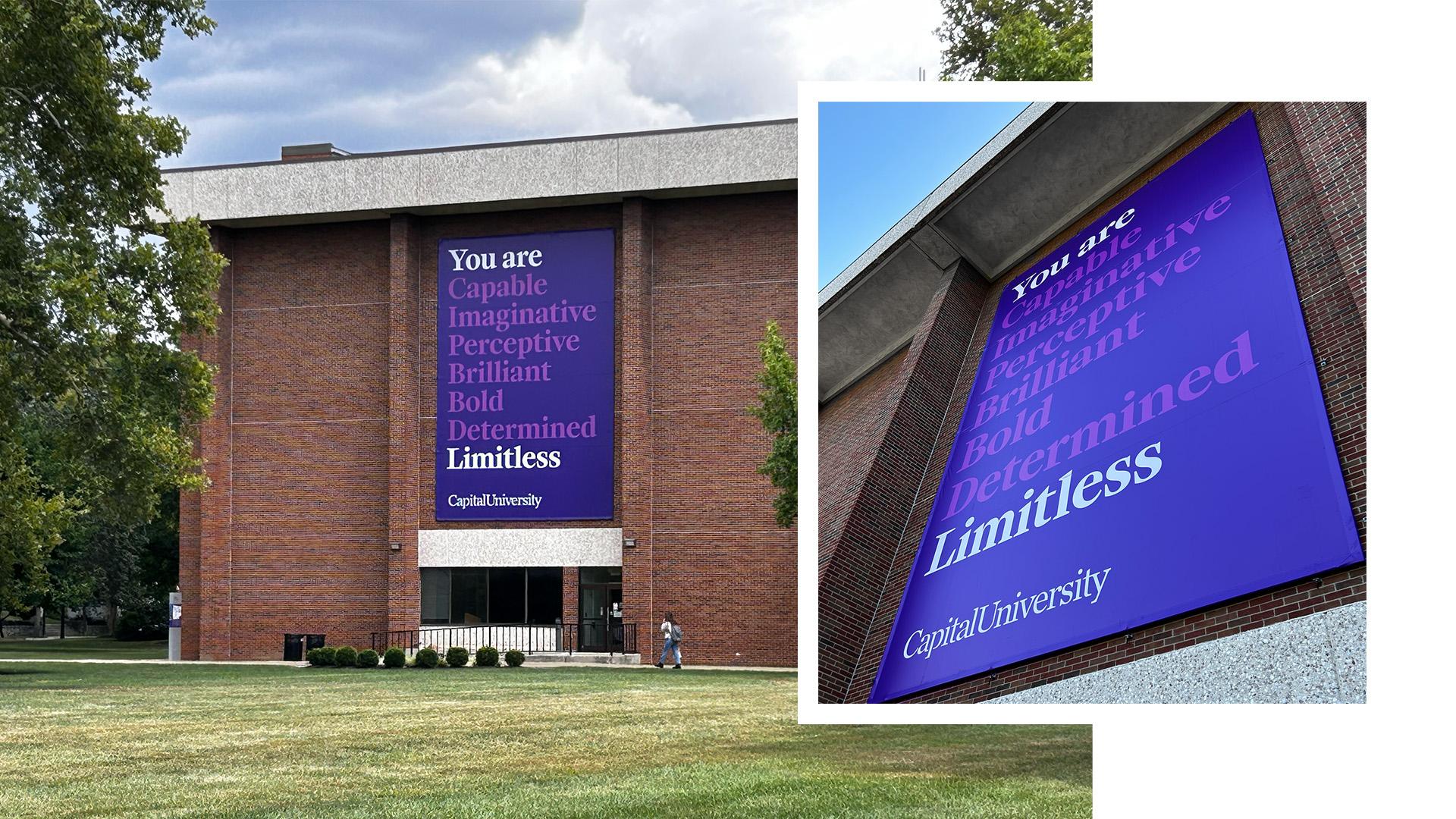
Stepping onto campus this past year, students, faculty, staff, and visitors may have noticed something different, a pop of color cutting through the familiar red brick. The Office of Admissions along College Avenue, once blending into the background, now stands with intention. And it’s not the only space that feels renewed.
According to John Pagliaro, professor and Associate Creative Director at Capital, the vision has been quietly forming for years. Pagliaro has been at Capital for 12 years and started thinking about transforming the campus walls nearly eight years ago.
“I’m always thinking about the brand on another level,” he said.
What began as an awareness of blank space evolved into something much larger: a comprehensive environmental design effort, the first of its kind on campus in over a decade.
“Capital transforms lives,” Pagliaro said. And more importantly, “We believe in students even when they don’t believe in themselves.”
Before any walls were redesigned, research came first. Nearly 1,900 prospective-age students nationwide were surveyed about their attitudes and perceptions. Messaging maps were created to guide voice and tone. Mockups and color palettes were circulated around campus, sparking small but meaningful conversations with faculty and students.
Visually, the transformation extends beyond Capital’s traditional purple. While purple remains brilliant and inspiring, new tones of orange, green, blue, and yellow were introduced to add warmth and accessibility.
“Purple can be brilliant or dark,” Pagliaro explained. “The magic wasn’t choosing colors; it was how to use them.”
Location was just as intentional as color. Older, highly visible areas were selected for revitalization, including spaces along College Avenue and Main Street. Installations were mapped meticulously, with staggered walls designed for drive-by recognition. Banner lengths were debated. Placement logistics were carefully coordinated. Every detail was considered.
Success looks like students feeling supported. It looks like a shared identity. It looks like a campus environment that grounds students and reminds them, year-round, that they belong.
“Branded environments constantly remind us we have a shared identity,” Pagliaro said. “Art makes the ordinary beautiful.”