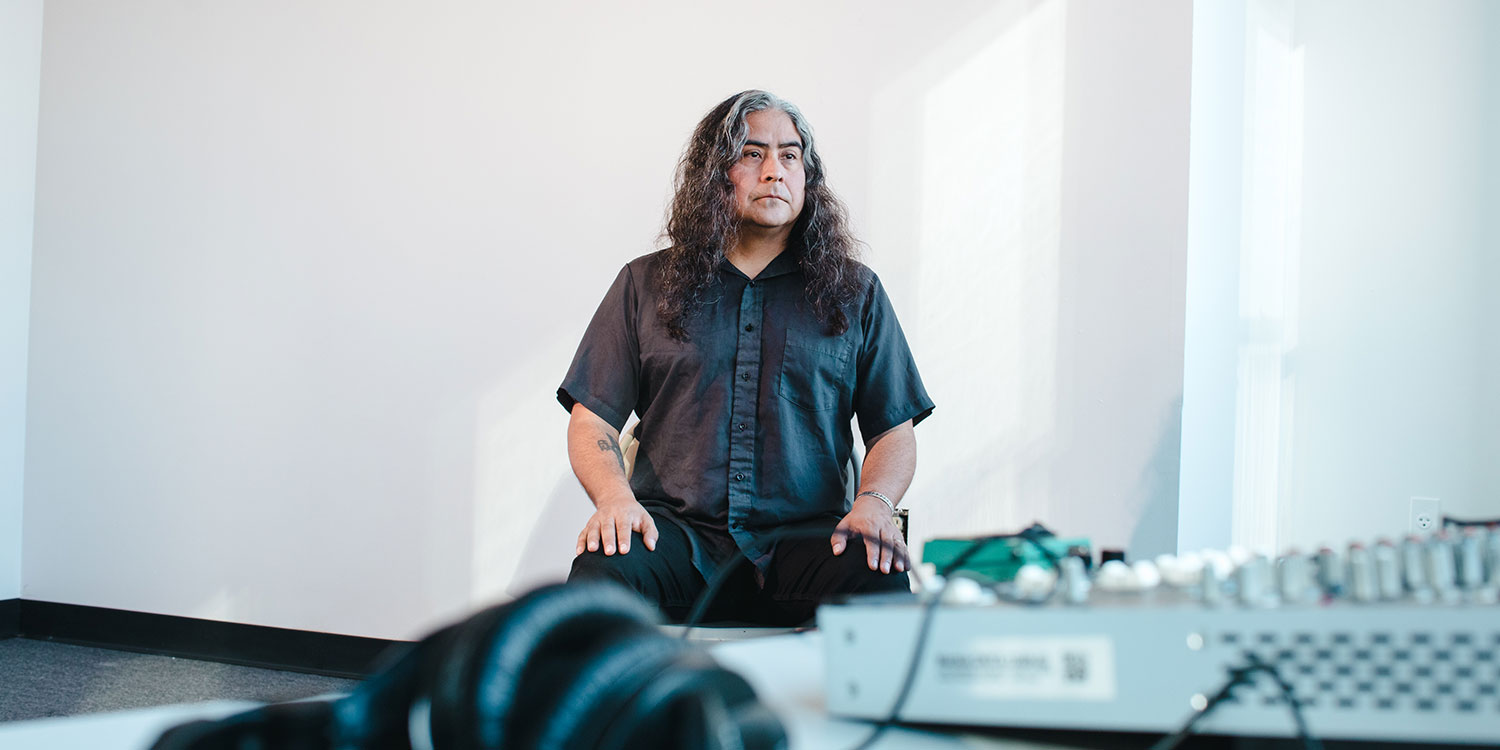
Capital’s NOW Festival has long been a space for bold ideas, boundary-pushing performances, and new ways of listening. This year, the Conservatory of Music welcomes acclaimed composer and artist Raven Chacon as its guest composer, an artist whose work embodies the festival’s spirit of experimentation, collaboration, and cultural reflection.
Chacon, a member of Navajo Nation, is known for a wide-ranging practice that spans experimental composition, improvisation, noise music, performance scores, and installation. While his work takes many forms, it is always rooted in sound and in the act of listening, both to music and to the world around us.
“There are some forms of Navajo music that I think I’ve sometimes referenced in the past because I was studying a lot of that type of music and thinking about the way it works, the way that it repeats, the duration of it,” said Chacon.
“But beyond that, I'm interested in making music I've never heard before. Maybe that's impossible, because I also believe that composers will make music that is a culmination of everything they've ever heard in their lives. I have influences that come from all directions. I’m a fan of loud music, rock, heavy metal, punk, and sometimes those influences peek through, even when I’m working on something like a string quartet.”
During his time at Capital, Chacon will work closely with students, culminating in a performance of “Voiceless Mass,” his Pulitzer Prize–winning work written for 12 musicians. The piece received the Pulitzer Prize in Music in 2022 and has since been performed widely. Its presence at the NOW Festival offers audiences not only a powerful musical experience, but also an opportunity for dialogue.
“It’s been nice to have this work performed in different places and to bring it to new audiences,” Chacon said. “A large part of what I’m coming to do is work with students. I like speaking with young composers and musicians about the possibilities of experimental music.”
As a young artist, he recalls having many unconventional ideas but little reassurance that they were worth pursuing.
“Nobody had really given me the go-ahead to say, ‘You can actually do that,’” he said. “Maybe people won’t understand it at first, or maybe you won’t have a big audience, but that’s okay.”
Improvisation plays a major role in Chacon’s work and worldview. He values spontaneous music that can never be repeated, viewing it as proof that creativity is ongoing and limitless. Collaboration fuels that process, whether he’s composing for an ensemble, responding to a specific theme or place, or working alongside other musicians in experimental settings. Those experiences continue to inform his compositional voice and his teaching philosophy.
“One of my favorite things to do is to listen to students’ music, to hear their ideas of how they're making music, to have a conversation about why it is we are even making music,” Chacon said. He is especially interested in breaking away from traditional concert expectations and using sound to build new connections.
“The work is to make people think differently about the world we live in, the sounds that exist in it, and what music can be. There are continually new tools being invented and hacked by musicians, as well as new instruments. Because of that, there are always unique ways to make sound and new ways to play. An instrument itself might be very old, but I’m always amazed at how musicians continue to find new ways to play it.”
To learn more about the NOW Festival at Capital, visit https://www.capital.edu/student-life/arts-and-culture/annual-events/now-festival.